TripIt vs Wanderlog vs Voyaij: Which One Plans and Organises Your Trip?
TripIt, Wanderlog and Voyaij all end with an itinerary, but they start in different places. TripIt builds your itinerary from confirmations you forward to plans@tripit.com, and can optionally connect to your inbox (Inbox Sync) to pick them up automatically. Wanderlog helps you plan a trip from a blank map before anything is booked. Voyaij covers both stages in one app: plan the trip with AI, then forward your confirmations as you book - without an inbox connection.
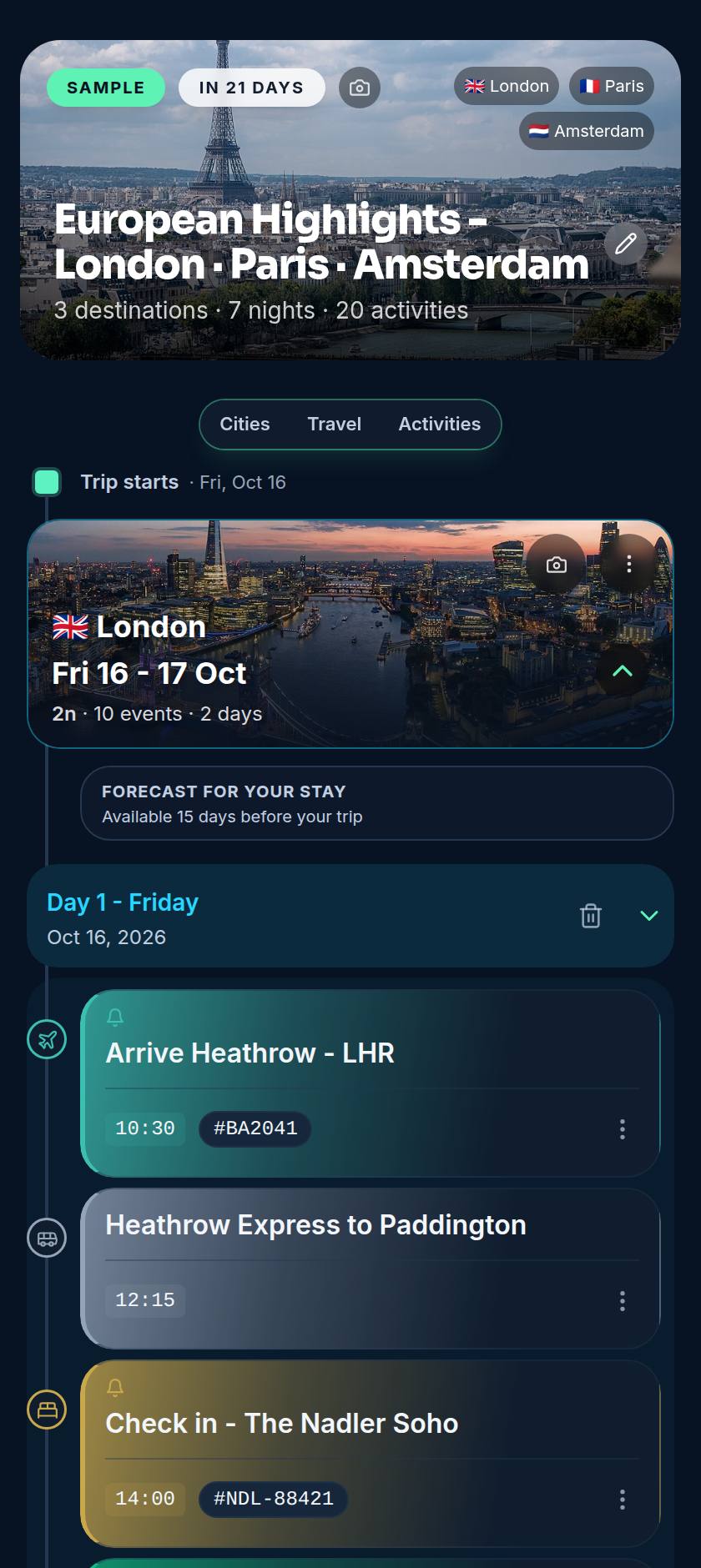
See what Voyaij builds for you
This is a real Voyaij itinerary built from booking confirmations, with every event on the right day and clash checks on every plan. Gate and delay show in the app on every plan; push alerts are on paid plans. Explore it yourself, no signup needed.
European Highlights - London · Paris · Amsterdam
Arrive Heathrow - LHR
10:30Heathrow Express to Paddington
12:15Check in - The Nadler Soho
14:00Walk the South Bank
17:00+ 3 cities, 6 nights in the full sample
What each app is built to do
TripIt is built for the traveller who has already booked everything and wants it organised in one place. It builds your itinerary from confirmations you forward to plans@tripit.com, and can optionally connect to your inbox (Inbox Sync) to pick them up automatically. Live flight alerts and a few other features sit behind a $49/year Pro plan.
Wanderlog takes the opposite starting point: a map. It's a genuinely strong tool for sketching a route, dropping pins on places you're considering, and collaborating on a plan before you've booked anything. Its free tier is unusually generous - unlimited places, collaboration and some booking import - and Pro is $39.99/year.
Voyaij covers both stages in one app. Before you book, you tell its AI trip planner where you'd like to go and roughly when, and it drafts the trip - cities, order, dates and nights - shaped by your Traveller DNA (your interests, pace and budget). It can then suggest an activity for each day. Once you've booked, you forward each confirmation to import@myvoyaij.com and it lands on the right day, one email at a time; Voyaij never connects to your inbox. During the trip, Radar ranks nearby places against your DNA, and Concierge suggests things to do on your free days and in gaps of three hours or more between plans.
Side by side
Best for
- Voyaij
- Planning a trip with AI, then organising the bookings
- TripIt
- Bookings you've already made
- Wanderlog
- Planning a trip from a blank map
Reads your confirmation emails
- Voyaij
- Forward-only, one at a time
- TripIt
- Forwarding, or optional inbox sync
- Wanderlog
- Import flights/hotels/cars; Gmail auto-scan on Pro
Ever connects to your inbox
- Voyaij
- No, never
- TripIt
- Optional (Inbox Sync)
- Wanderlog
- Optional on Pro (auto Gmail scanning)
Live flight gate & delay alerts
- Voyaij
- In the app on every plan, push on paid plans
- TripIt
- Pro plan only
- Wanderlog
- Not the focus
Map-first trip building
- Voyaij
- No - AI drafts the route as a day-by-day itinerary
- TripIt
- No
- Wanderlog
- Yes, its core strength
Bring your TripIt history over
- Voyaij
- One-pass import from a TripIt export
- TripIt
- -
- Wanderlog
- Not built for this
Free tier
- Voyaij
- Full itinerary builder; plain email forwards free; 10 AI credits/mo for PDFs, Concierge and the AI planner; first AI-planned trip free
- TripIt
- Organiser with sharing, calendar sync and offline access; no real-time alerts
- Wanderlog
- Generous - unlimited places, collaboration
Paid plan, billed annually
- Voyaij
- $49.99/yr (Starter)
- TripIt
- $49/yr (Pro)
- Wanderlog
- $39.99/yr (Pro)
| Voyaij | TripIt | Wanderlog | |
|---|---|---|---|
| Best for | Planning a trip with AI, then organising the bookings | Bookings you've already made | Planning a trip from a blank map |
| Reads your confirmation emails | Forward-only, one at a time | Forwarding, or optional inbox sync | Import flights/hotels/cars; Gmail auto-scan on Pro |
| Ever connects to your inbox | No, never | Optional (Inbox Sync) | Optional on Pro (auto Gmail scanning) |
| Live flight gate & delay alerts | In the app on every plan, push on paid plans | Pro plan only | Not the focus |
| Map-first trip building | No - AI drafts the route as a day-by-day itinerary | No | Yes, its core strength |
| Bring your TripIt history over | One-pass import from a TripIt export | - | Not built for this |
| Free tier | Full itinerary builder; plain email forwards free; 10 AI credits/mo for PDFs, Concierge and the AI planner; first AI-planned trip free | Organiser with sharing, calendar sync and offline access; no real-time alerts | Generous - unlimited places, collaboration |
| Paid plan, billed annually | $49.99/yr (Starter) | $49/yr (Pro) | $39.99/yr (Pro) |
Checked on each product's own site on 25 September 2026: tripit.com/web/pro/pricing, help.tripit.com (Inbox Sync), wanderlog.com/pro.
Pricing and feature details are public information as of writing and can change - worth double-checking on each product's own site before you decide.
TripIt vs Voyaij: the real difference
The table above covers all three tools. If you're weighing Voyaij against TripIt specifically, these are the three differences that actually change how it feels to use.
With TripIt
Inbox sync is optionalInbox sync is optional
Many people turn on Inbox Sync for convenience; the connection then stays live while it's enabled.
Live alerts, gated
Gate and delay alerts sit behind a separate $49/year Pro plan.
History needs an export
TripIt does not push your old trips into another app. You download a data export first.
With Voyaij
Forward-onlyNever connects to your inbox
You forward exactly the confirmation you want read. One email in, one booking read - that's the entire access it ever had.
Live alerts included
Gate and delay updates show in the app on every plan, and push alerts come with every paid plan, no separate add-on.
Bring your history with you
Import a TripIt export and your full trip history converts in one pass - years of it, not just what's new.
Coming from TripIt? Bring your whole history over
Voyaij reads a TripIt data export - the file TripIt's own export tool produces - and converts your full trip history into Voyaij trips in one pass. Years of past travel, not just bookings from today onward. No retyping, no starting over.
Why "never connects to your inbox" is the whole point
An inbox-connected tool is convenient because it works passively - but it also means the app can see every email in that inbox, not just your travel bookings, for as long as the connection stays live. That's a real trade-off some travellers are happy to make and others aren't.
Voyaij's forward-only model is slightly more active - you send the confirmation yourself - in exchange for a hard boundary: there is no "link your Gmail" step, ever, and a shared family inbox can't leak a surprise trip you haven't announced yet. One email in, one booking read, and that's the entire access it ever had.
Things to do on your trip
Whichever planner you land on, here are popular tours and activities you can book ahead - powered by GetYourGuide.
Plan a trip or forward a booking, and see for yourself
No inbox connection to set up, no card required. Describe a trip to the AI planner and get a draft route, or forward a booking to import@myvoyaij.com and watch it become a day-by-day itinerary.
Frequently asked questions
Is Voyaij better than TripIt?+
It depends what you need. TripIt builds an itinerary from confirmations you forward to plans@tripit.com, and can optionally connect to your inbox. You can add plans there too. Voyaij only ever sees the one email you forward. Flights, hotels and car hire come in on every plan. Trains, tours and other activities import on Starter and Pro, and you can add them by hand on every plan. Clash and missing-booking flags are on every plan. Gate and delay updates show in the app on every plan; push alerts are on Starter and Pro, included in the plan rather than a separate flight add-on. TripIt Pro is $49 a year (checked 11 Oct 2026) and includes a deeper set of airport tools. Voyaij Starter annual is $49.99, so this is not a cheaper-alerts pitch. Upload a TripIt data export to bring your history across.
Is Voyaij better than Wanderlog?+
They start from different places. Wanderlog is a map-first planner for building a trip from scratch - dropping pins, sketching a route, collaborating on ideas before anything is booked. Voyaij plans with AI rather than on a map: describe the trip and it drafts the cities, dates and nights, shaped by your Traveller DNA. Then, as you book, forward each confirmation and it lands on the right day automatically. If you like to plan visually on a map, Wanderlog's map view is genuinely strong. If you'd rather have AI draft the plan and keep your bookings in the same app, Voyaij does more of that work for you.
How does Voyaij's AI trip planner work?+
Tell it where you'd like to go and roughly when - "ten days in Portugal in May", say. It asks at most one follow-up question at a time, then drafts the trip: the cities, their order, arrival and departure dates, and the nights in each. If you've filled in your Traveller DNA (interests, pace, budget, comfort zone), the draft leans towards your style. You can edit the draft or create the trip straight away, and Voyaij can then suggest an activity for each day (up to the first 14 days). On the free plan your first AI-planned trip costs nothing; after that each planner reply uses 3 AI credits from your monthly allowance (10 on Free, 50 on Starter, 150 on Pro) or from a top-up pack, and day suggestions use 2 credits a day.
Can I import my TripIt history into Voyaij?+
Yes. Voyaij reads a TripIt data export (the file TripIt's own GDPR/data-export tool produces) and converts your full trip history into Voyaij trips in one pass - years of past travel, not just new bookings going forward.
Does Voyaij connect to my email inbox like TripIt does?+
No, and this is the main structural difference between the two. TripIt builds your itinerary from confirmations you forward to plans@tripit.com, and can optionally connect to your inbox (Inbox Sync) to pick them up automatically. Voyaij never does - there is no "link your Gmail" step. You forward exactly the confirmations you want read to import@myvoyaij.com, one at a time, and that single email is all Voyaij ever sees.
Which one should I use: TripIt, Wanderlog or Voyaij?+
If you're planning a trip from a blank slate and want a map to sketch it on, try Wanderlog. If you want AI to draft the trip and then keep your bookings organised in the same app, without connecting it to your inbox, try Voyaij. If an optional inbox connection and a mature set of airport tools matter more, TripIt does that job too. All three are worth trying against your own actual trip.