The route
The drive itself - which roads, which direction, how far between towns. This lives in a maps app; it is the one piece Voyaij does not do.
A road trip is the one kind of travel where the plan keeps moving - new stops, shifting nights, and long stretches with no signal. Here is how to plan one properly: map the route, space your overnight stops, budget the drive, and keep the whole itinerary in one place that still works when the bars disappear.
The drive itself - which roads, which direction, how far between towns. This lives in a maps app; it is the one piece Voyaij does not do.
The overnight stops are the backbone of a road trip. Each one is a town and a number of nights, in order along the route.
Fuel, tolls, parking and accommodation, plus a buffer for detours. Road trips have costs a flight-and-hotel trip never does.
Car hire, hotels and any activities you have reserved - the confirmations you will actually need to show on the day.
Every road trip starts with the line on the map. Use a maps app for that: drop your overnight towns as pins, check the driving time between them, and adjust until no single day is a slog. Voyaij is not a mapping tool - that job belongs to Google Maps or a dedicated route planner.
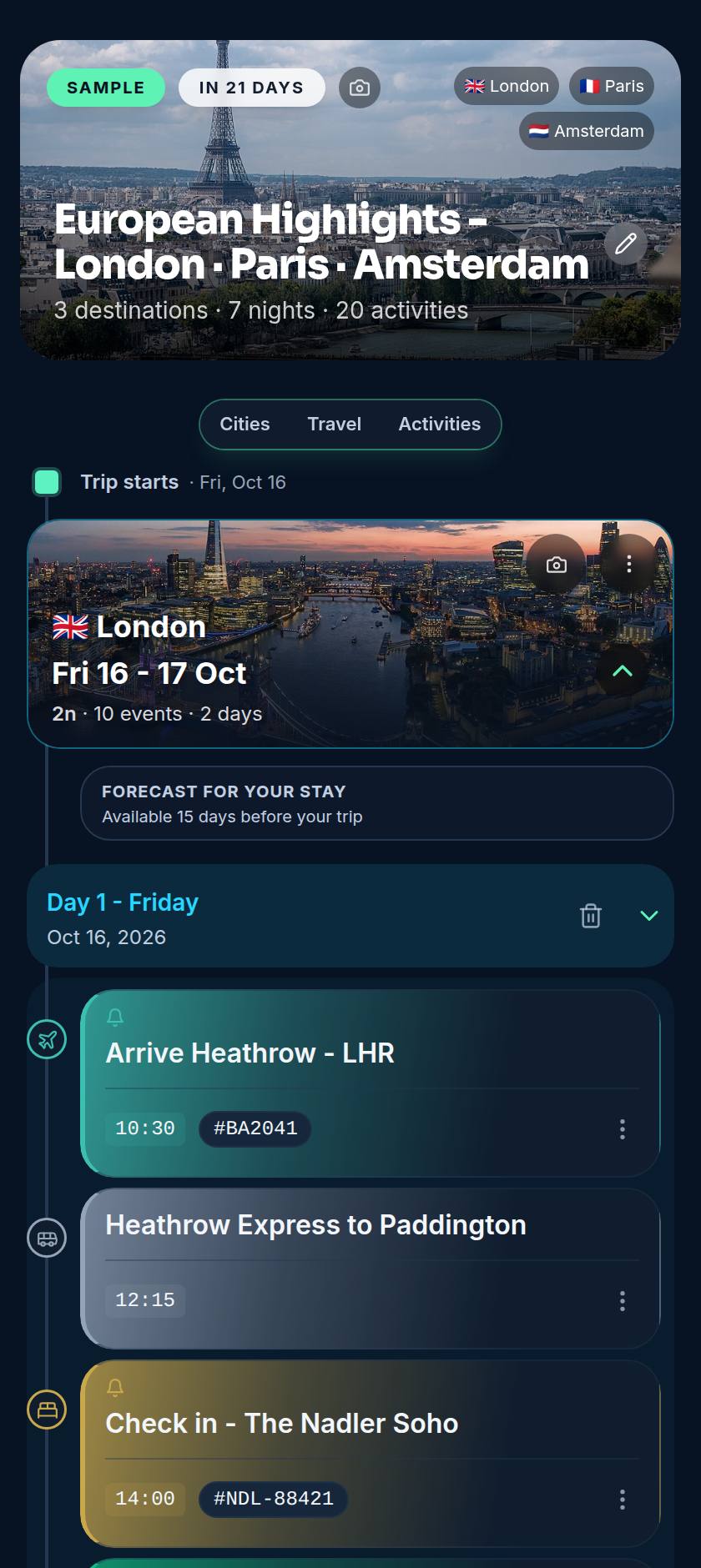
Once the route is set, the plan becomes a list of real commitments: a car to collect, hotels booked for specific nights, a tour halfway along. That is the part that gets messy - scattered across confirmation emails, useless the moment you have no signal. That is what Voyaij is built for.
Forward the rental confirmation and the pickup and drop-off times and locations land on your timeline as their own events.
Each hotel along the route slots in as a stop with the right check-in, check-out and nights, in chronological order.
Your whole plan is cached on your phone, so it opens in the dead zones where a road trip needs it most.
Everyone in the car sees the same stops, times and confirmation numbers, kept in sync when a booking changes.
Forward your car-hire and hotel confirmations to import@myvoyaij.com and the AI builds the day-by-day plan - every stop, in order, with the times and references you will need on the road.
Plan 5 to 6 hours of driving a day to leave room for the stops that make the trip. Long-haul days burn people out fast.
Coastal roads, national-park loops and scenic drives sell out their good accommodation months ahead. Lock the stops first.
These are the costs people forget. Estimate them up front so the trip total is realistic, then pad it 10 to 15%.
Break up the drive with something worth stopping for. Here are popular tours and activities you can book ahead - powered by GetYourGuide.
Map your route in your favourite maps app, then let Voyaij hold the rest - car hire, every overnight stop, the day-by-day plan, shared with your co-driver and ready offline. Free plan, no credit card.
Not a map tool, and we will not pretend otherwise. For the actual driving route and stops along the way, a maps app like Google Maps is still the right tool. Voyaij is for everything around the drive: it parses your car-hire and hotel confirmations, turns your overnight stops into a day-by-day plan, works offline on the road, and keeps the whole thing shared with whoever is travelling with you.
A good rule of thumb is no more than 5 to 6 hours of actual driving per day if you want to enjoy the stops, or up to 8 if you are covering distance. Build in a break every 2 hours, and avoid arriving at a new town after dark on the first night. Spacing your overnight stops sensibly is the single biggest thing that makes a road trip relaxing instead of a marathon.
Start with your route and the towns you want to overnight in, then book accommodation for each stop. Forward each hotel confirmation to Voyaij and it becomes a stop on your timeline with the right nights, in order. Add the car-hire pickup and drop-off the same way, and you have a complete multi-stop itinerary without typing anything in by hand.
Yes, which matters more on a road trip than almost any other kind of travel. Highways, mountain passes and rural stretches drop signal constantly. Once your trip has loaded, Voyaij caches it on your device, so your stops, check-in times and confirmation numbers are all there with no connection.
Yes. Add them as a travel partner and they see the same itinerary - the route stops, the bookings, the times. On a road trip where you swap driving and navigating, having both people on the same plan saves a lot of 'which exit was it?' moments.
Beyond accommodation, the road-trip-specific costs are fuel, tolls, parking and the odd one-way car-hire fee. Estimate fuel from your total distance and the vehicle's economy, add a generous allowance for tolls on motorway-heavy routes, and keep a 10 to 15% buffer for detours and the snacks that a road trip somehow always needs.